
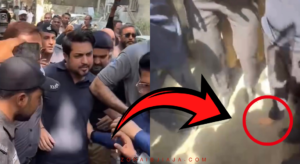
A brief incident involving Iqrar-ul-Hassan’s slipper outside a Karachi court has triggered debate over publicity stunts and the media’s role in turning minor moments into viral stories.
A seemingly minor moment during Iqrar-ul-Hassan’s appearance at Karachi City Court on October 19 has raised a broader question about celebrity, cameras and how easily ordinary incidents can become media spectacles.
Judicial Magistrate (East) Gulraiz Memon rejected the National Cyber Crime Investigation Agency’s request for further physical custody and sent the television anchor and Awam Raj Tehreek chief to jail on judicial remand until October 26 in a case registered under the Prevention of Electronic Crimes Act.
According to accounts of what happened as he was being moved from court, Iqrar briefly stopped and said that his slipper had come off. Cameras and content creators around him then focused on his bare feet, while people nearby reportedly offered him footwear.
The brief scene quickly attracted attention.
But was it spontaneous — or deliberately created to draw cameras?
There is currently no verified evidence establishing that Iqrar-ul-Hassan intentionally staged the moment. A complete independently authenticated recording demonstrating advance planning has not emerged, nor has Iqrar or anyone involved publicly confirmed that it was designed as a publicity stunt.
Without such evidence, describing it as a deliberate stunt would be speculation.
When Publicity Stunts Really Were Staged
There are, however, well-documented examples in international entertainment where apparently spontaneous incidents were later confirmed as carefully planned performances.
In 2009, Joaquin Phoenix shocked television audiences with his unusual behaviour and supposed decision to abandon acting for a rap career. Director Casey Affleck later acknowledged that the transformation depicted in I’m Still Here, including Phoenix’s notorious public appearances, was a performance rather than a genuine breakdown.
That same year, Eminem and Sacha Baron Cohen generated headlines when Cohen, appearing as Brüno, landed on Eminem during the MTV Movie Awards. Eminem later confirmed that the incident had been planned and rehearsed in advance.
In 2018, Banksy’s Girl with Balloon began passing through a shredder hidden inside its frame immediately after being sold at Sotheby’s. The event became one of the art world’s most famous publicity spectacles, transforming the partially shredded work into Love is in the Bin.
Another widely viewed example came in 2013, when customers at a New York coffee shop appeared to witness a woman using telekinetic powers. The dramatic scene was actually an elaborate marketing stunt created to promote the horror film Carrie, using actors, hidden cameras and mechanical effects.
In each of these cases, subsequent evidence or direct acknowledgement established that planning had taken place.
Did the Cameras Create the Story?
The Iqrar-ul-Hassan episode raises a different journalistic question.
In an environment where television cameras, YouTubers and social-media creators follow prominent personalities closely, even a misplaced slipper can become viral material within minutes.
That does not necessarily mean the person at the centre of the footage designed the incident.
Sometimes the media itself amplifies an otherwise insignificant moment, particularly when the individual involved is already part of a major political or legal story.
The distinction matters. A publicity stunt requires some evidence of intention or planning. Viral attention alone does not prove either.
For now, the available evidence supports only one cautious conclusion: the slipper incident attracted considerable camera attention, but there is insufficient verified evidence to establish that it was deliberately staged for publicity.